

Ask a plant controller where profit quietly leaks out of the P&L, and shift handover rarely tops the list. It should. The few minutes between one crew clocking out and the next clocking in are where equipment gets damaged, safety hazards go unflagged, and bad batches slip through unnoticed.
Most factories still treat this moment as an afterthought—a rushed verbal debrief or a few scribbled lines in a logbook. Multiply that gap across every line, every shift, every day of the year, and the losses stack into six figures before anyone notices a pattern.
Here's why the handover window is more dangerous than most plant managers realize, and the simple framework that closes the gap for good.
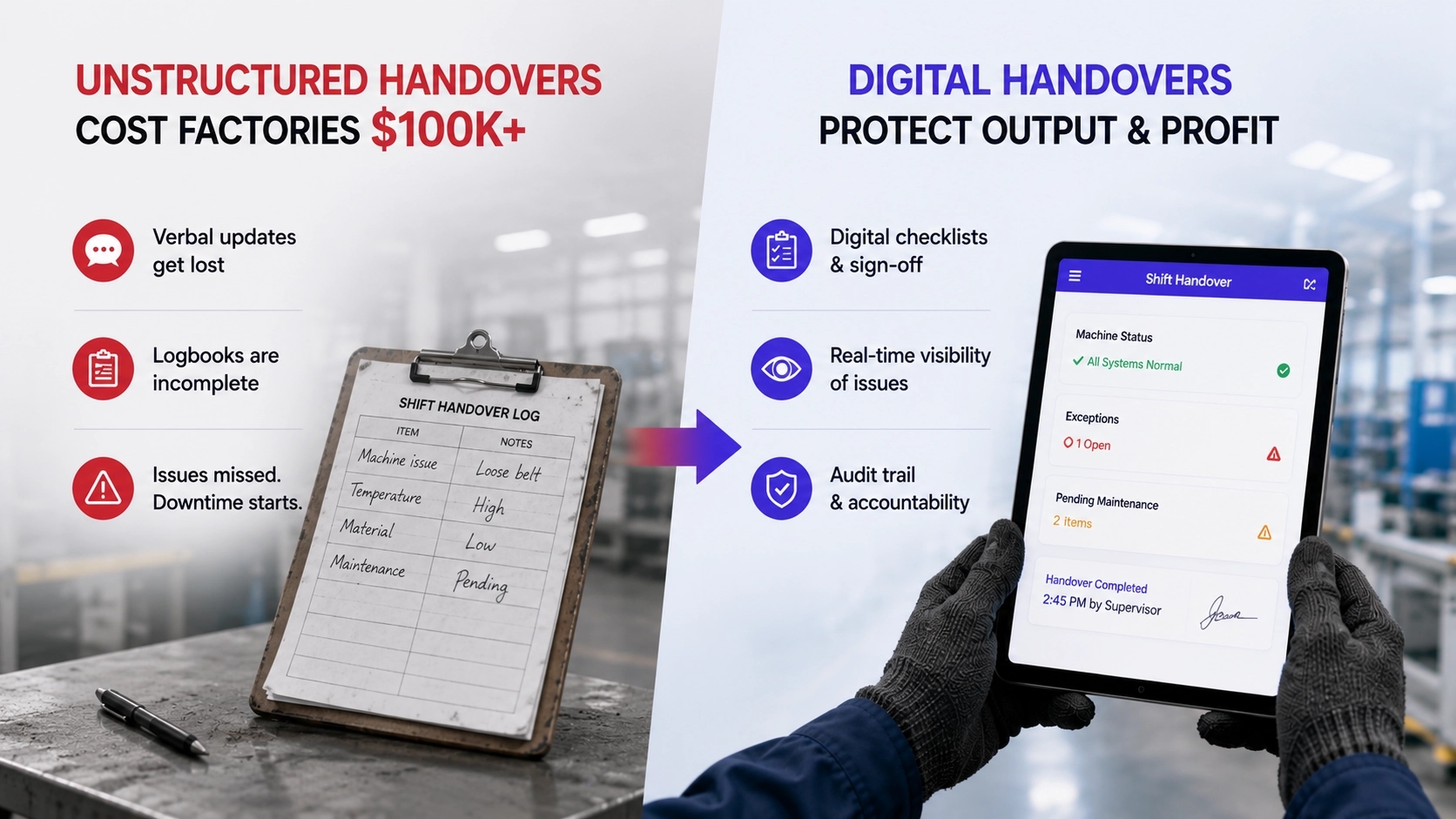
An estimated 60% of daily manufacturing errors occur during the first 120 minutes of a new shift—the exact window where incoming operators are still piecing together what actually happened on the line before them.
A rushed handshake at the machine or a few messy lines in a shared logbook forces incoming operators to run on assumptions instead of verified facts. Details get lost, context gets diluted, and the new shift inherits problems it never sees coming.
Incoming operators run machines on the previous shift's custom settings without resetting parameters, straining equipment and shortening its usable life.
Maintenance hazards or temporary safety bypasses from the outgoing shift go unflagged, carrying real risk straight into the next crew's hands.
Quality checks that weren't logged at shift change lead directly to bad batches rolling off the line before anyone catches the issue.
Operators spend the first 30 minutes of every shift simply figuring out what happened during the last one—time that should be spent running production, not reconstructing history.
Outgoing supervisors must sign off on machine status and any pending alerts before clocking out, closing the door on undocumented issues.
Incoming teams see flagged exceptions instantly on their tablets, rather than digging through paper clipboards buried at the back of a binder.
Timestamped, visual logs give management a clear record of exactly when each handover happened and who signed off on it.
A $100k+ annual loss doesn't announce itself—it accumulates in small, unflagged gaps that repeat every single shift. Fixing the handover process is one of the fastest, lowest-cost ways to protect equipment, safety, quality, and output all at once.
Ready to close the gap between shifts?
Download our free 5-Point Shift Handover Checklist Template or Schedule a 10-minute demo to digitize your shift transitions.