


In regulated manufacturing—whether Pharmaceutical, Fine Chemical, or Food/FMCG—audit readiness is often judged by the strength of your documentation. Yet, QA/QC Heads, Plant Managers, and Regulatory Inspectors frequently encounter the exact same gap during facility audits: the gap between what the eQMS says in the office and what actually happens on the shop floor.
While enterprise electronic Quality Management Systems (eQMS) excel at managing high-level change controls, CAPAs, and global SOP approvals, they rarely reach the machine operator level. As a result, daily line clearances, equipment cleaning logs, CCP monitoring, and shift handovers remain tethered to paper clipboards and physical binders.
This reliance on paper doesn't just slow down operations—it creates critical data integrity vulnerabilities that threaten compliance under ALCOA+ principles (Attributable, Legible, Contemporaneous, Original, Accurate, plus Complete, Consistent, Enduring, and Available).
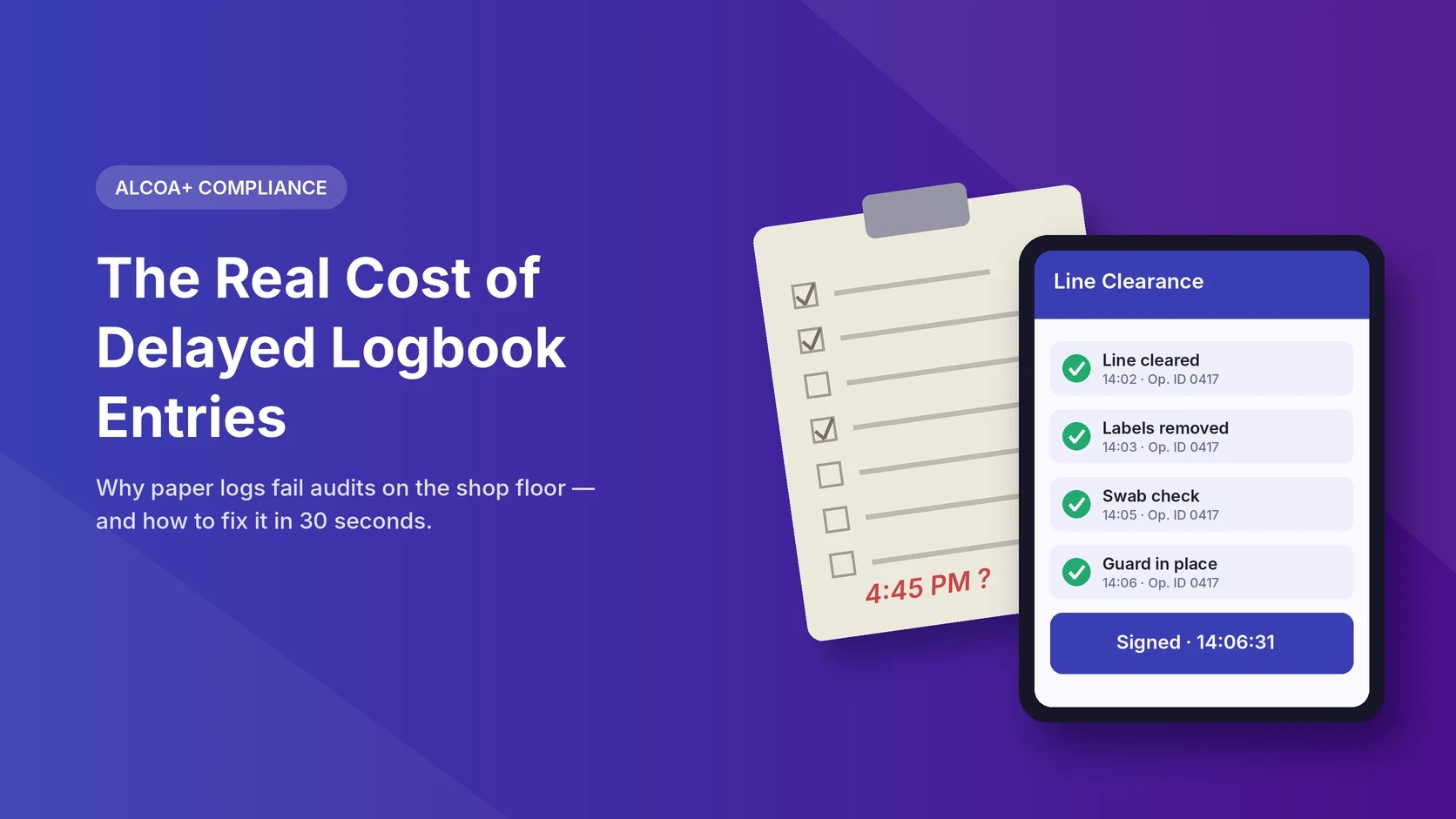
The "5 PM Logbook Rush": Where ALCOA+ Integrity Breaks Down
Ask any plant QA Lead what happens 15 minutes before a shift handover, and you will hear a familiar story.
An operator working on a busy production or packaging line focuses on meeting shift output targets. Recording routine environmental checks, cleaning verifications, or line clearance parameters on a paper sheet attached to a clip-holder gets deferred until the end of the shift.
At 4:45 PM, right before clocking out, the operator sits down with a stack of paper logbooks to fill in signatures, timestamps, and readings—retroactively from memory.
During an unannounced USFDA, MHRA, WHO, or FSSAI audit, this scenario manifests as costly inspection findings:
Non-Contemporaneous Entries
Batch records and timestamps that fail to align with machine SCADA/PLC runtime logs.
Illegible Handwriting & Manual Errors
Unreadable operator initials or transcription mistakes that delay batch release.
Lack of Physical Evidence
Inability to verify whether a line clearance or swab check was physically completed or simply checked off on paper.
Buried Out-of-Trend (OOT) Signals
Gradual process shifts buried in paper pages that go unnoticed until a full Out-of-Specification (OOS) deviation occurs.
Why Enterprise ERPs and eQMS Don't Solve Shop-Floor Execution
Most modern manufacturing plants already run multi-million-dollar ERPs (SAP, Oracle, Microsoft Dynamics) alongside enterprise QMS software. However, these systems were built for desktop workstations, complex workflows, and corporate reporting.
Expecting a machine operator in a cleanroom or a high-dust production area to log onto a full desktop ERP terminal to complete a 30-second pre-start check creates friction. When software is cumbersome, operators revert to paper clipboards, and managers are forced to transcribe paper logs into spreadsheets later.
To achieve genuine ALCOA+ compliance, plant teams need a last-mile mobile verification layer—a lightweight, floor-friendly tool that captures data at the exact moment of execution without interrupting production.
4 Keys to Achieving 100% Real-Time Data Integrity on the Floor
Transitioning from physical logbooks to digital audit trails doesn't require overhauling your entire IT infrastructure. By focusing on simple, operator-first workflows, plant heads can eliminate data integrity risks across every shift:
1. Enforce Real-Time Timestamping (Contemporaneous Logging)
By replacing paper logbooks with mobile or floor-tablet checksheets, every parameter entry, line clearance sign-off, and supervisor verification is automatically stamped with the exact date, time, and operator ID. Retrospective logging becomes physically impossible, securing 100% compliance under ALCOA rules.
2. Require Mandatory Photo Evidence for Critical Checks
Paper clipboards allow an operator to check a box without verifying physical equipment status. Mobile checksheets allow plant leads to mandate live photo uploads for critical steps—such as verifying cleanroom cleanliness, label line clearance, or machine guard placement—before the digital workflow allows the operator to proceed.
3. Automate Flagged Alerts for Parameter Drift (OOT Prevention)
Instead of waiting for QA to manually review paper binders at the end of the week, digital checksheets validate parameter inputs against pre-set operating limits instantly. If a temperature, pressure, or weight entry drifts out of trend (OOT), the system flags an immediate alert for the shift supervisor to intervene before batch quality is compromised.
4. Turn 5 Days of Excel Audit Prep into a 3-Click PDF Export
When auditors arrive on-site, QA teams typically spend days pulling physical logbooks, cross-referencing shift handovers, and compiling Excel summary sheets. With continuous digital logging, plant leads can filter historical records by line, shift, operator, or date range and export complete, immutable PDF audit trails in seconds.
Eliminating the Paper Friction on Your Shop Floor
Audit preparation shouldn't mean chasing physical binders or worrying about retrospective logbook entries. When shop-floor verifications are fast, digital, and operator-friendly, compliance happens naturally as part of the daily shift routine.
At CrewMento, we designed the Frontline Compliance & Verification Suite specifically to bridge the gap between enterprise ERPs and shop-floor execution. Operators complete 30-second line clearances, shift handovers, and EHS safety audits on low-cost tablets with instant timestamps and photo proof—keeping your plant 100% audit-ready, every day.
Ready to See How It Works on Your Floor?