

Walk onto the production floor of any batch manufacturing facility in Ankleshwar, Vapi, Tarapur, or Sanand during a product changeover, and you will see the exact same bottleneck.
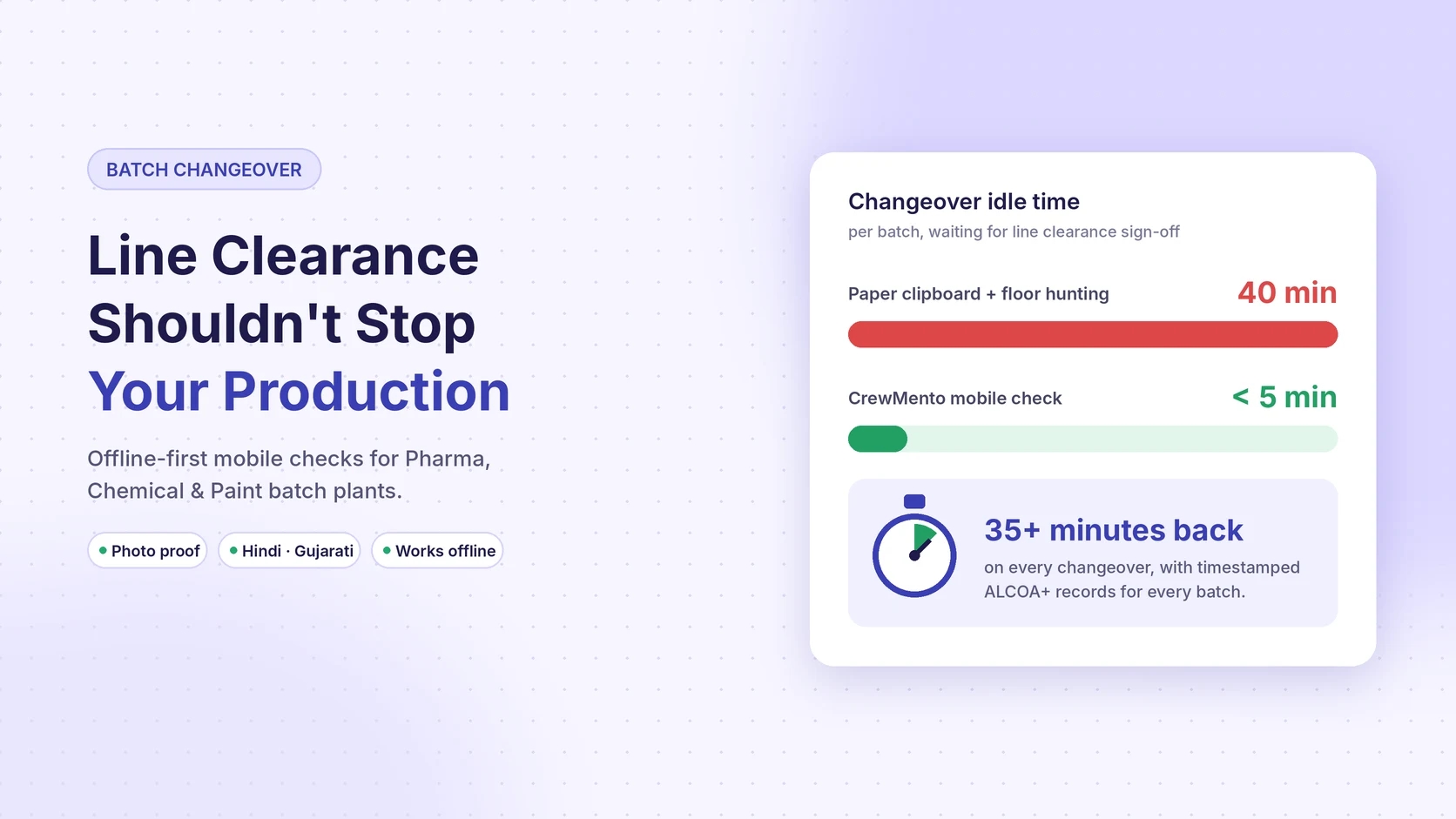
The mixing vessel is washed. The packaging line is cleared of previous labels. The machine operator is standing ready to start the next batch. Yet the line sits idle for 30 to 45 minutes.
Why? Because the shift supervisor and QA officer are walking across two floors with a paper line-clearance clipboard—or waiting for someone to verify whether the previous batch's remnants were actually cleaned out.
In Pharma, Specialty Chemicals, and Paint manufacturing, line clearance is non-negotiable. Skipping steps leads to cross-contamination, shade mismatch, label mix-ups, and batch rejection. But when line clearance relies on physical clipboards and manual chasing, plants lose hundreds of productive machine hours every month—while still failing to capture verifiable proof for ISO, WHO, or FDA auditors.
Where Paper-Based Line Clearance Breaks Down on the Floor
Most plants already have detailed Standard Operating Procedures (SOPs) for line clearance. The problem isn't the SOP—it is how the verification happens at the machine level:
The "Sign-Off Chase" Between Production and QA
Operators finish cleaning a reactor or filling line, then have to leave their station to locate a supervisor or QA inspector. Until both physical signatures land on the paper sheet, the batch cannot start. Across three shifts and multiple changeovers a day, 25 minutes of waiting per changeover adds up to over 40 hours of lost capacity per line every month.
Tick-Box Compliance Without Physical Verification
Under shift pressure, a paper checklist makes it easy to tick "Hopper cleaned and free of previous batch material" or "Previous batch cartons removed" without close inspection. Weeks later, if a cross-contamination complaint or customer rejection surfaces, an ink tick mark on paper proves nothing.
Language Friction for Contract and Floor Operators
Standard SOP binders are written in formal English. On the shop floor, machine operators and helpers are far more comfortable reading instructions in Hindi, Gujarati, or Marathi. When an operator has to guess what a checklist line means—or waits for a supervisor to translate—errors and delays multiply.
Dead Wi-Fi Zones in Reactor and Cleanroom Areas
Many plants try digitizing checklists using web forms or cloud apps, only to hit a wall inside thick-walled cleanrooms, solvent zones, or basement packaging bays where mobile data and Wi-Fi drop out. The moment an app freezes or spins while loading, operators abandon it and go back to paper.
4 Ways High-Performing Plants Speed Up Line Clearance (Without Cutting Corners)
Eliminating changeover bottlenecks does not require replacing your ERP or slowing down QA rigor. It requires moving line clearance verification directly to the point of work on a floor-ready mobile device:
1. Replace Paper Clipboards with Offline-First Mobile Checksheets
Operators and supervisors run the exact line-clearance checklist on a standard Android phone or rugged tablet right at the machine—even with zero internet connectivity. Every check is saved locally with an automatic, tamper-proof timestamp and syncs to the cloud the moment the device reconnects.
2. Mandate Live Photo Proof at High-Risk Checkpoints
Instead of relying on a checkbox alone, QA Heads can require a live camera photo for critical steps—such as clean vessel interiors, zero-label verification on packaging lines, or filter integrity checks—before the checklist allows the operator to move forward.
3. Let Operators Switch Languages with One Tap
When an operator can toggle the exact same line-clearance SOP between English, Hindi, or Gujarati in one second, instructions are understood clearly the first time—while QA still receives a standardized, audit-ready English report in the backend.
4. Trigger Instant Supervisor Sign-Offs Instead of Floor Hunting
The moment an operator completes pre-start checks and uploads photo proof, the shift supervisor or QA officer receives an immediate alert to review and digitally sign off—cutting changeover idle time from 40 minutes down to under 5 minutes.
Turn Line Clearance from a Bottleneck into an Audit Asset
Line clearance shouldn't force a trade-off between production speed and compliance rigor. When operators have a fast, offline-capable checklist in their own language—backed by live timestamps and photo proof—changeovers move faster and every batch starts with complete ALCOA+ traceability.
At CrewMento, we built our Frontline Compliance & SOP Execution App specifically for Indian batch manufacturers—so your floor teams can run 30-second line clearances, cleaning logs, and shift handovers on standard Android devices, even in zero-Wi-Fi zones.
Ready to See How It Works on Your Floor?
100% Offline-First • Auto-Syncs When Online • Multi-Language (English, Hindi, Gujarati)