


31 July 2026
In high-stakes industrial environments—from pharmaceutical manufacturing and life sciences to precision chemical processing and discrete assembly—the margin for error on the plant floor is practically zero. Yet walk into almost any factory today, and you'll still find dusty ring binders sitting on workbenches, laminated paper checklists taped to control panels, and operators relying on memory during peak operational shifts.
Paper-based systems were designed for a simpler era of manufacturing. Today, as supply chains demand higher throughput, tighter regulatory compliance, and faster cycle times, relying on physical binders and paper checklists is no longer just inefficient—it's an expensive operational liability. A single skipped step on a shop floor checklist can trigger a multi-thousand-dollar batch rejection, an unscheduled assembly line shutdown, or severe regulatory fines.
To protect margins and maintain quality, forward-thinking operations leaders are moving beyond static paper documentation and transitioning to Digital Standard Operating Procedure (SOP) Verification.
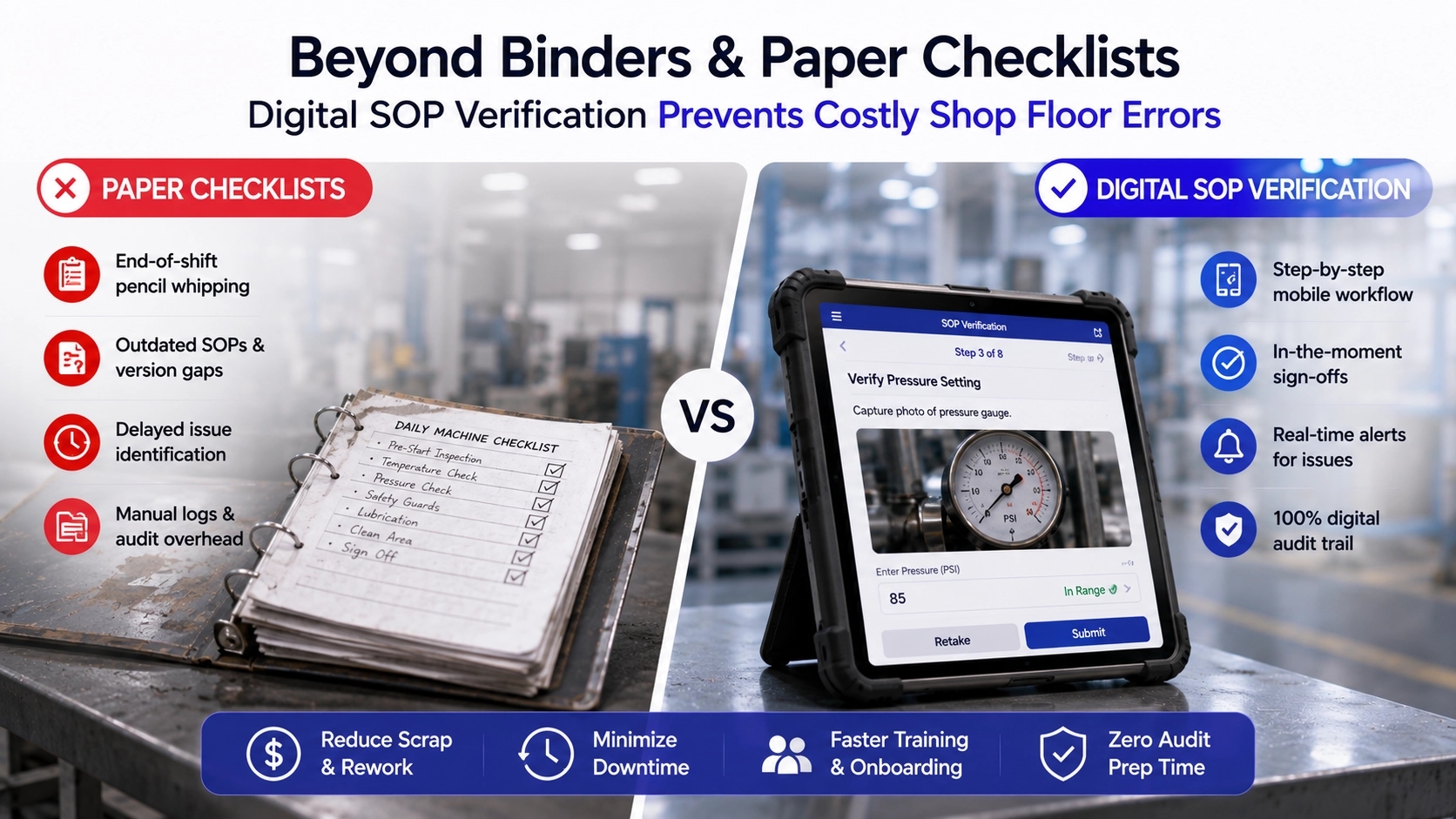
On paper, paper seems harmless. It's cheap to print, easy to hand to an operator, and familiar to floor managers. But the true cost of paper-based SOP management is hidden in execution failures, compliance gaps, and untracked downtime.
When operators rush to hit end-of-shift production targets, filling out physical logbooks often becomes a secondary priority—leading to checking off every box at once at shift-end rather than verifying each action as it's performed. Management gets a completed piece of paper, but zero assurance that compliance actually occurred.
When safety protocols or machine guidelines change, outdated paper SOPs frequently remain in circulation on the floor long after revision cycles—and any resulting defects or violations rest entirely on broken document distribution.
If an operator notices a temperature anomaly or a misaligned calibration step on a paper checklist, that data sits in a physical tray until shift-end or the next day's audit—by which point hundreds of non-compliant units may already be produced.
When auditors or enterprise clients request proof of compliance, QA teams spend days hunting through filing cabinets and manually verifying signature lines—draining high-value engineering hours.
Digital SOP Verification converts traditional, static instruction manuals into interactive, real-time digital workflows executed on mobile devices, tablets, or ruggedized shop-floor hardware. Unlike a static PDF stored on a desktop, a true digital SOP system guides frontline workers step-by-step through their shift procedures, requiring proof of completion before the next step can begin.
Direct input of measurements, temperatures, and machine parameters as they happen.
Photo, video, or barcode verification required for critical steps.
Operators automatically see only the SOPs relevant to their active role, station, and shift.
Automated escalation to floor supervisors the moment a parameter falls outside acceptable thresholds.
Automated, tamper-proof logs showing who performed a task, when, and how long it took.
| Traditional Paper SOPs | Digital SOP Verification |
|---|---|
| Static PDF / binder on shelf | Dynamic step-by-step mobile workflow |
| End-of-shift pencil whipping | In-the-moment timestamped sign-offs |
| Manual audit logs & lost papers | Automated, 100% compliant digital audit trail |
| Delayed issue identification | Instant real-time alerts for out-of-spec steps |
Step order matters. Skipping a pre-heating phase or adding an additive too early can ruin an entire production cycle. Digital SOPs enforce strict sequencing—step two can't be accessed until step one is verified and logged.
Text-heavy binder manuals leave room for interpretation, especially for new or multi-lingual operators. Annotated images and short video demonstrations let workers match what they see on screen to the machine in front of them—cutting human error dramatically.
Instead of a simple checkmark, digital verification requests physical proof for high-risk steps—scanning a barcode to confirm a raw material lot, photographing a torque setting, or capturing a digital signature.
When an operator logs an out-of-spec parameter, the platform immediately notifies shift supervisors and maintenance leads—so management intervenes right away instead of running non-compliant equipment for hours.
Upgrading from paper binders to digital SOP verification isn't just a technology refresh—it's a direct line-item cost reduction for plant operations.
Catching procedural deviations at step 3 instead of step 30 prevents entire batches from ending up in the scrap bin.
Preventive digital inspection checklists catch equipment issues during pre-shift handovers before they escalate into sudden mechanical failures.
Digital, guided workflows can cut the time to bring new frontline operators up to full productivity by up to 50%, softening the impact of high workforce turnover.
Since every task, timestamp, and verification is logged automatically, audit prep shrinks from days of binder hunting to seconds of digital report generation.
Relying on paper checklists and binders in modern manufacturing creates an unnecessary operational risk. Every manual logbook sitting on a workbench represents a potential blind spot—a place where communication can fail, human errors can go unnoticed, and downtime costs can multiply.
By shifting to Digital SOP Verification, operations and plant leaders gain complete visibility into shop floor execution—equipping frontline staff with the clear, step-by-step tools they need to perform flawlessly, while securing the real-time compliance tracking required to stay competitive.
Ready to take your SOPs out of the binder?
See how CrewMento turns static paper checklists into real-time digital SOP verification—with sequential step enforcement, media proof, instant alerts, and audit-ready logs, no complex IT setup required.