


13 July 2026
Ask any Plant Manager what the most vulnerable 15 minutes of their day is, and they won't say a regulatory audit or a supply chain delay. They will point to shift handover.
When Shift A shuts down and Shift B steps up to the machines, a critical exchange of operational data must happen. In thousands of manufacturing plants across India and globally, this vital process still relies on an outdated, fragile technology: the physical paper logbook.
Operators jot down notes in messy handwriting, sign off on pre-start safety checklists without verifying conditions, or orally pass along machine quirks over the noise of the floor.
The result? A multi-million-dollar facility running modern, high-precision machinery relies on a paper process prone to human error—costing factories hundreds of hours of preventable downtime every single year.
On a typical line running three shifts a day, an inefficient, manual handover leaks capacity in two distinct ways:
If operators spend 10 to 15 minutes per shift filling out paper binders, looking for clipboards, or waiting for supervisors to sign off on physical checklists, that is 45 minutes of lost production time every single day. Over a year (300 operational days), that equals 225 hours of pure idle machine time per line.
When Shift A fails to accurately record a minor machine anomaly—such as a slight thermal spike, a loose sensor, or a material feed misalignment—Shift B takes over completely blind. The machine runs for an hour before seizing up, causing an unexpected shutdown that takes the maintenance team 3 to 4 hours to diagnose and repair. Across a medium-sized plant running 4 to 6 production lines, these preventable, handoff-related micro-stoppages easily compound into over 800 hours of lost capacity annually.
While plant leadership sets strict Standard Operating Procedures (SOPs), paper systems actively work against frontline operators:
A supervisor only discovers an operator skipped a vital pre-start calibration after the line breaks down.
Under pressure to meet shift quotas, workers fast-track paperwork by checking off boxes automatically rather than inspecting the machine.
When recurring machine failures occur, digging through stacks of oily paper binders to find past handover logs is practically impossible.
Modernizing factory handovers doesn't mean forcing floor workers to adopt heavy enterprise software that takes weeks to learn. The goal is frictionless digital verification.
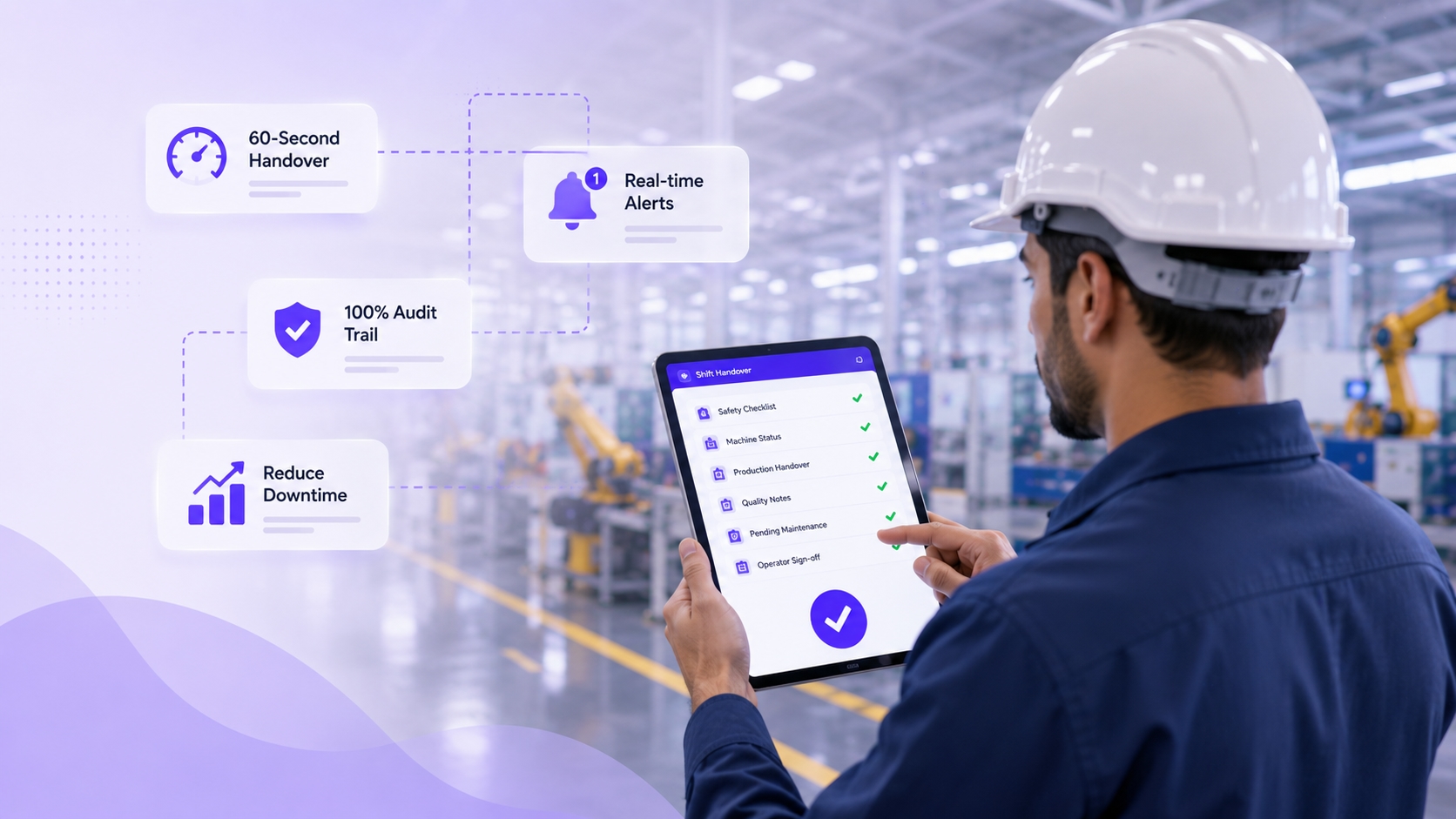
By transitioning shift handovers to a 60-second digital checkup on a mobile or tablet screen right at the machine, plants unlock immediate operational gains:
Supervisors don't need to read hundreds of green checkmarks. If a worker flags a machine anomaly or skips a safety SOP during handover, the system immediately fires a real-time alert to the floor manager.
Digital prompts ensure every shift follows the exact same pre-start steps—eliminating variations between day and night shifts.
Every sign-off is timestamped digitally, providing instant liability protection during internal or external audits.
Modern tools run directly off standard weekly shift rosters (using simple Excel/CSV uploads), removing the need for months-long IT integration projects.
Increasing factory throughput doesn't always require buying expensive new machinery or expanding floor space. Often, the fastest way to reclaim lost output is by fixing the daily operational seams between your shifts.
By eliminating manual logbooks and empowering frontline teams with 60-second digital handovers, plant heads can stop shift-change friction, protect equipment longevity, and reclaim hundreds of hours of profitable production time.
Ready to eliminate manual shift friction on your floor?
Discover how CrewMento equips plant managers with 60-second digital shift handovers, automated exception alerts, and 100% audit-ready digital logs—without requiring complex IT setups.